The Language Of Invisible Barriers
The Language Of Invisible Barriers
The Language Of Invisible Barriers
CLIENT:
CLIENT:
Maire
Maire
SERVICE:
SERVICE:
Communication
Communication
Communication
YEAR:
YEAR:
2026
2026
In Italy, only 16.8% of young women graduates hold a STEM degree. Figures like this have kept gender equality in STEM at the centre of public conversation, yet they say little about what happens to the women who choose these careers: the expectations no one states, the language that shapes how competence is judged, the fatigue that builds up over the years.
With MAIRE, we set out to look below the surface of the data. Variabili Nascoste (Hidden Variables) is a research and communication project that maps the unspoken factors shaping the relationship between women and STEM, and turns them into a shared language for the whole group.
CHALLENGE
The public story of women in STEM moves between two registers: percentages and heroines. Our analysis of twelve months of editorial content, reports and social conversations confirmed it. Close to half of the terms in circulation revolved around gaps, indicators and trends, while roughly a third was built on corrective verbs such as bridge, reduce, support. The numbers were believed, but rarely recognized.
History follows the same pattern. Ada Lovelace wrote the first algorithm in 1843 and was remembered as Byron's daughter; Rosalind Franklin produced Photo 51, yet the 1962 Nobel Prize for the structure of DNA went to Watson, Crick and Wilkins; Katherine Johnson, Dorothy Vaughan and Mary Jackson calculated NASA trajectories and stayed nameless for decades. Presence, contribution, reduction, erasure. When women appear in the story today, they appear as exceptions, and ordinary competence, the kind that builds most careers, finds little room.
How do you make visible a barrier that works because nobody names it? For MAIRE, the question was also strategic: inclusion policies hold only if they reach the daily experience of the people they concern.
CHALLENGE
The public story of women in STEM moves between two registers: percentages and heroines. Our analysis of twelve months of editorial content, reports and social conversations confirmed it. Close to half of the terms in circulation revolved around gaps, indicators and trends, while roughly a third was built on corrective verbs such as bridge, reduce, support. The numbers were believed, but rarely recognized.
History follows the same pattern. Ada Lovelace wrote the first algorithm in 1843 and was remembered as Byron's daughter; Rosalind Franklin produced Photo 51, yet the 1962 Nobel Prize for the structure of DNA went to Watson, Crick and Wilkins; Katherine Johnson, Dorothy Vaughan and Mary Jackson calculated NASA trajectories and stayed nameless for decades. Presence, contribution, reduction, erasure. When women appear in the story today, they appear as exceptions, and ordinary competence, the kind that builds most careers, finds little room.
How do you make visible a barrier that works because nobody names it? For MAIRE, the question was also strategic: inclusion policies hold only if they reach the daily experience of the people they concern.
SOLUTION
We started from a silence. The interviews with professionals, researchers and students showed that the distance between narrative and experience rarely surfaces as open conflict. It settles into tiredness and silence: the hesitation before asking a question, a tone adjusted to sound more credible, a career quietly reshaped after maternity.
That silence gave the project its image: a waterline. Above it sits the manifest barrier, the one visible in charts and campaigns. Below it, the hidden variables do their work. From this image, we developed:
A two-phase qualitative research. A 12-month analysis of the public conversation identified four recurring narrative areas, which became the tracks for in-depth interviews with women at different stages of a STEM path, from university to career development. Each testimony was read as interpretive material, used to confirm or challenge the barriers found online.
Four hidden variables, each with its own pair of claims. The distance of numbers, the pressure to adapt, excellence as a threshold and permanence as a private matter. Each variable is written as a manifest barrier and its reversal: "Seen as a percentage / Seen", "Adapt to belong / Belong as you are", "Be the exception / Be the standard", "Yours to fix / Shared support".
A visual identity built on the waterline. Every layout is split in two, violet above and deep navy below. The lower claim is mirrored like a reflection of the one above, so reading it requires a change of perspective. The Variabili Nascoste mark sits on the line with its colors inverted, NASCOSTE reflected beneath VARIABILI.
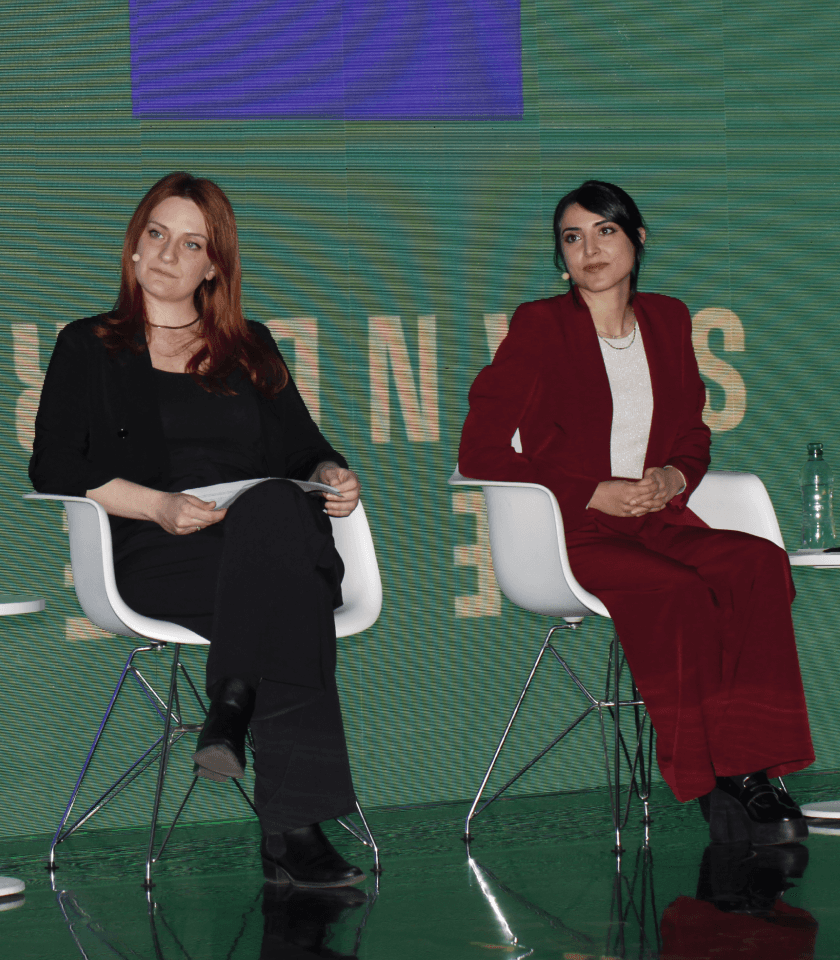
An event for International Women's Day. On 8 March, the findings were presented and discussed with President Fabrizio Di Amato, Francesca Familiari (Head of Group Compliance, Ethics, Diversity & Inclusion) and Chiara Nidasio (Group Brand Marketing Manager), joined by science communicator Gaia Contu, a PhD candidate in robot ethics, and philosophy communicator and radio host Esmeralda Moretti.
A multichannel social campaign. MAIRE's Instagram, LinkedIn and YouTube channels carried the institutional story of the project, while Gaia Contu and Esmeralda Moretti brought the research to their own audiences with creative and educational content.
A playbook to put the variables to work. For each variable, the playbook moves from context and research to concrete actions, split between what people can do straight away and what needs a longer horizon, and closes with a section dedicated to language.
Two objects for everyday work. A notebook with a die-cut flap that completes the cover when closed and keeps the explained variable inside. A lenticular print that shows both claims of a variable as the viewer tilts it. Both carry the waterline onto employees' desks, keeping the research present long after the event.
Today, MAIRE has a name for what used to stay unspoken, and a set of tools to act on it, from the meeting room to the daily routine. Because the first step to removing a barrier is being able to see it.
SOLUTION
We started from a silence. The interviews with professionals, researchers and students showed that the distance between narrative and experience rarely surfaces as open conflict. It settles into tiredness and silence: the hesitation before asking a question, a tone adjusted to sound more credible, a career quietly reshaped after maternity.
That silence gave the project its image: a waterline. Above it sits the manifest barrier, the one visible in charts and campaigns. Below it, the hidden variables do their work. From this image, we developed:
A two-phase qualitative research. A 12-month analysis of the public conversation identified four recurring narrative areas, which became the tracks for in-depth interviews with women at different stages of a STEM path, from university to career development. Each testimony was read as interpretive material, used to confirm or challenge the barriers found online.
Four hidden variables, each with its own pair of claims. The distance of numbers, the pressure to adapt, excellence as a threshold and permanence as a private matter. Each variable is written as a manifest barrier and its reversal: "Seen as a percentage / Seen", "Adapt to belong / Belong as you are", "Be the exception / Be the standard", "Yours to fix / Shared support".
A visual identity built on the waterline. Every layout is split in two, violet above and deep navy below. The lower claim is mirrored like a reflection of the one above, so reading it requires a change of perspective. The Variabili Nascoste mark sits on the line with its colors inverted, NASCOSTE reflected beneath VARIABILI.
An event for International Women's Day. On 8 March, the findings were presented and discussed with President Fabrizio Di Amato, Francesca Familiari (Head of Group Compliance, Ethics, Diversity & Inclusion) and Chiara Nidasio (Group Brand Marketing Manager), joined by science communicator Gaia Contu, a PhD candidate in robot ethics, and philosophy communicator and radio host Esmeralda Moretti.
A multichannel social campaign. MAIRE's Instagram, LinkedIn and YouTube channels carried the institutional story of the project, while Gaia Contu and Esmeralda Moretti brought the research to their own audiences with creative and educational content.
A playbook to put the variables to work. For each variable, the playbook moves from context and research to concrete actions, split between what people can do straight away and what needs a longer horizon, and closes with a section dedicated to language.
Two objects for everyday work. A notebook with a die-cut flap that completes the cover when closed and keeps the explained variable inside. A lenticular print that shows both claims of a variable as the viewer tilts it. Both carry the waterline onto employees' desks, keeping the research present long after the event.
Today, MAIRE has a name for what used to stay unspoken, and a set of tools to act on it, from the meeting room to the daily routine. Because the first step to removing a barrier is being able to see it.





OTHER WORKS
S.2]
G-Shock
An Unbreakable Icon
G-Shock
An Unbreakable Icon
G-Shock
An Unbreakable Icon

Ministero dell'Ambiente e della Sicurezza energetica
Al pianeta teniamo un mondo
Ministero dell'Ambiente e della Sicurezza energetica
Al pianeta teniamo un mondo
Ministero dell'Ambiente e della Sicurezza energetica
Al pianeta teniamo un mondo

Wasa, Barilla Group
Wasa Global Website
Wasa, Barilla Group
Wasa Global Website
Wasa, Barilla Group
Wasa Global Website

BC&
Not just a tax & legal firm
BC&
Not just a tax & legal firm
BC&